


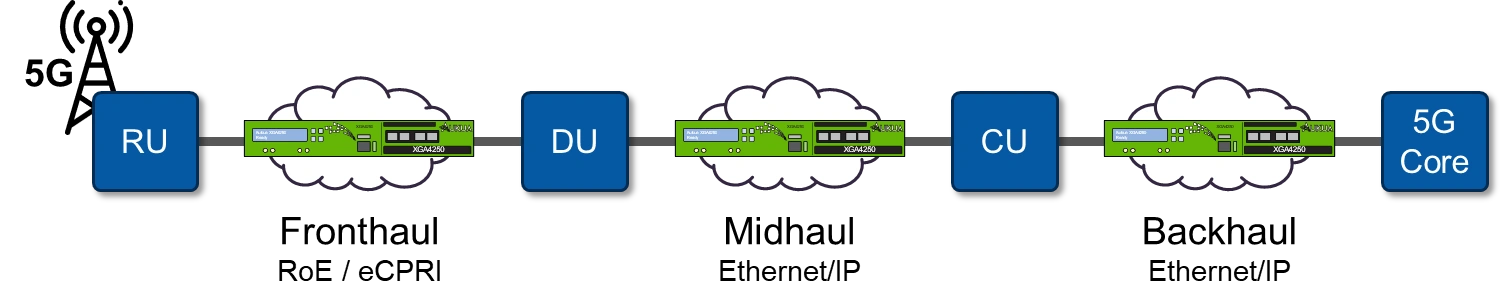
5G mobile technology promises to support the demand for higher bandwidth services, lower latency requirements, and to cope with the rapidly rising number of devices connecting to the network. To meet this challenge, while also reducing deployment costs, operational costs and increasing flexibility, 5G networks utilize an open model of the Radio Access Network (RAN). This splits functions between the Centralized Unit (CU), Distributed Unit (DU) and the Radio Unit (RU), and the O-RAN Alliance was formed to create open interface specifications.
In addition, the RAN is moving to a packet switched architecture to increase bandwidth efficiency and add flexibility. These packet based networks like Ethernet introduce new issues such as delay variation and packet loss, causing problems with timing protocols and latency sensitive applications being transported over the RAN. For this reason the RAN hardware and applications running over the RAN must be thoroughly tested and qualified while under the presence of real-world network delay and impairments.

Ensure high availability of your RAN by introducing real-world packet delay and impairments in your testing.
Verify and demonstrate fail-over mechanisms.
Determine how packet loss, congestion, and other network impairments affect functionality and stability.
Precisely measure latency to confirm it meets minimum design requirements. Prove synchronization can be properly delivered across a packet network in the presence of packet delay variation (PDV).
Gain better visibility when troubleshooting with line rate packet capture and nanosecond timestamp resolution. A simple intuitive GUI design and full api support for automation, remove barriers to testing operation.

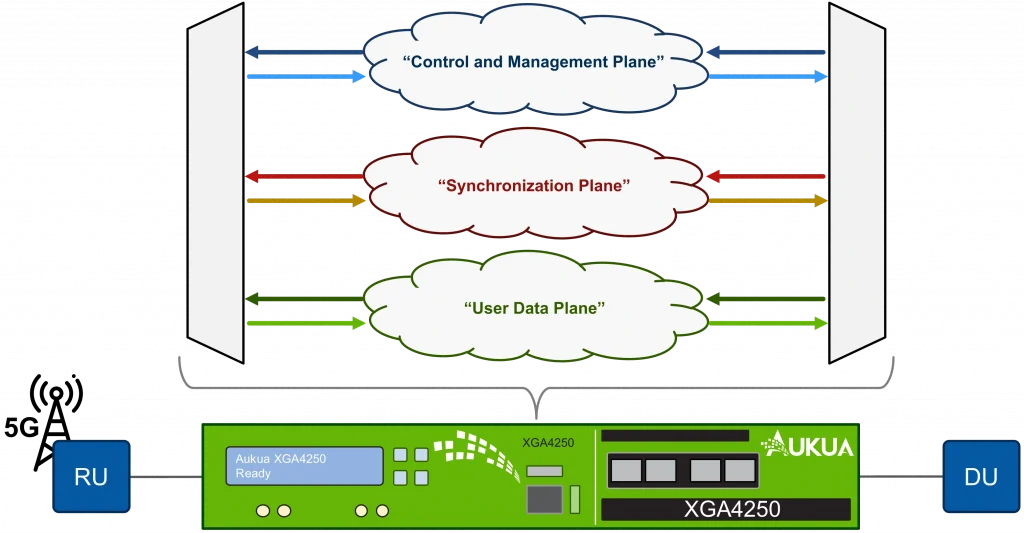
The XGA4250 targets specific protocols or streams to insert unique delay, packet jitter (PDV), drop, corruption and more.
For example: target eCPRI packets within the User Plane or PTP and SyncE packets within the Synchronization Plane.

Comprehensive solution enabling real-world testing of 5G Open RAN networks

Verify throughput performance, accurately measure one-way or two-way latency, or conduct real-time Bit Error Rate (BER) testing to prove system integrity. The traffic generator also has unique support for proprietary protocols, and a powerful PCAP Player.
Repeatable and programmable "real-world" testing in the lab insert delay, limit bandwidth, or introduce network impairment conditions for negative functional testing, to efficiently reproduce customer found problems, or for realistic performance testing. Ethernet and Fibre Channel supported.
Transparently sit inline between systems under test to capture packets with nanosecond precision timestamps. Monitor traffic in real-time, and gain visibility to quickly troubleshoot hard to find problems. Perform event timing correlation and analysis.